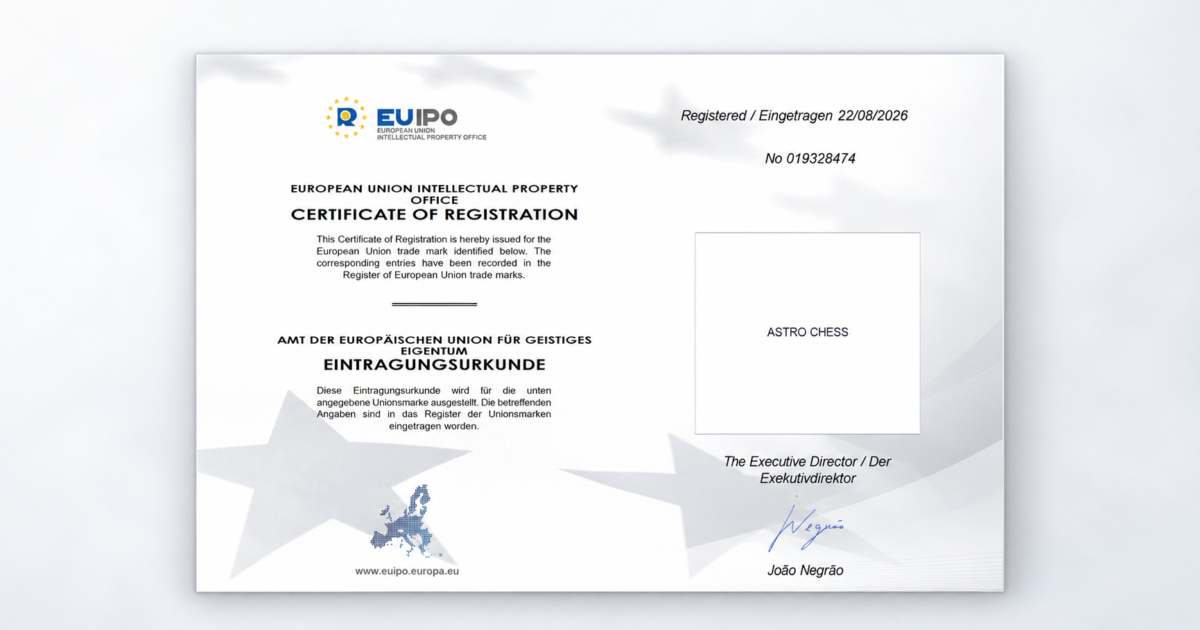
Astro Chess – A New Perspective on Chess Potential and Player Development
Chess is a game of knowledge, experience, discipline, decision-making, and psychological stability. Yet anyone who has worked with players for a longer period knows that results do not depend only on how much theory someone knows or how well they solve tactical exercises.
Two players with very similar knowledge can react completely differently in the same position. One will look for complications, the other for safety. One may become more precise under pressure, while another may begin to lose objectivity. One player needs highly structured training, while another progresses most when given enough space for personal creativity.
It was precisely this question that led to the development of Astro Chess.
What Is Astro Chess?
Astro Chess is a research and development concept that connects chess, individual player characteristics, and astrological analysis.
Its purpose is not to replace a chess coach, game analysis, or classical chess training.
It can be described more precisely in one sentence:
Chess coaches teach the game. Astro Chess helps us understand the player.
Astro Chess aims to offer an additional perspective on questions such as:
- What kind of thinking comes more naturally to a player?
- How does the player respond to pressure and competitive tension?
- What type of motivation drives the player most strongly?
- Where might the player’s natural psychological strengths lie?
- Which developmental patterns may be associated with internal obstacles?
- How can coaches or parents adapt their support more effectively to the individual player?
These are not questions about openings or chess variations. They are questions about the person sitting at the chessboard.
Potential Is Not the Same as Current Performance
One of the important ideas behind Astro Chess is the distinction between current playing strength and developmental potential.
A young player may currently have a relatively modest rating while still having considerable room for development. On the other hand, another player may improve very quickly at an early stage but later experience a significant slowdown.
Development is influenced by many factors:
- quality of training,
- environment,
- amount of competitive play,
- motivation,
- health,
- psychological stability,
- financial and family circumstances,
- coaching,
- the amount of time a player can devote to chess,
- and many other influences.
Astro Chess therefore does not assume that a single method can “predict the future”.
The aim is different: to contribute additional information to the understanding of a player’s potential and development.
For Players, Parents, and Coaches
Astro Chess can be useful in different ways.
For players, it may provide a better understanding of their own decision-making style, psychological reactions, and developmental patterns.
For parents of young chess players, it can offer an additional perspective on how to support a child without forcing them into a developmental model that may not suit them.
For coaches, it can serve as an additional tool for individualising their work.
One player needs more structure. Another needs more freedom. One responds well to direct criticism, while another may close down because of it. One becomes more dangerous under pressure, while another needs more work on stability and routine.
Astro Chess is designed precisely for this level of understanding.
The Research Component
Astro Chess did not develop solely as an interpretative astrological concept.
In recent years, the project has also developed a research component, in which specific hypotheses are tested using data from chess players with known birth data and documented competitive performance.
The research includes statistical testing, group comparisons, and examination of whether certain patterns occur more frequently within particular groups of players.
It is important to emphasise that this is a process.
Internal model validation is not the same as definitive proof. The next step is therefore always testing on new data that were not used in model development.
External validation is what ultimately shows whether a model can retain its predictive value outside the original sample.
Astro Chess Biorhythm
Another part of the concept is the Astro Chess Biorhythm.
While natal analysis focuses mainly on relatively stable characteristics of a player, the biorhythm addresses changes over time.
The basic idea is that a player is not always in the same psychological and energetic state.
There may be periods when a player is:
- more decisive,
- more creative,
- psychologically more stable,
- more impulsive,
- more inclined to take risks,
- or more susceptible to fatigue and internal pressure.
The Astro Chess Biorhythm is based on monitoring astrological transits and their possible relationship with a player’s competitive periods.
Here too, the purpose is not to “predict the result of a game”, but to better understand the timing context in which the player is competing.
Astro Chess Is Not a Substitute for Chess Training
This needs to be stated clearly.
Astro Chess does not replace:
- a coach,
- game analysis,
- tactical training,
- opening preparation,
- endgame training,
- psychological work,
- or practical tournament experience.
It is an additional tool.
If traditional chess training answers the question:
How can this player play better?
Astro Chess attempts to add another question:
What kind of player is this person, and how can their development be supported in a way that suits them better?
It is in this combination that I see the greatest potential of the concept.